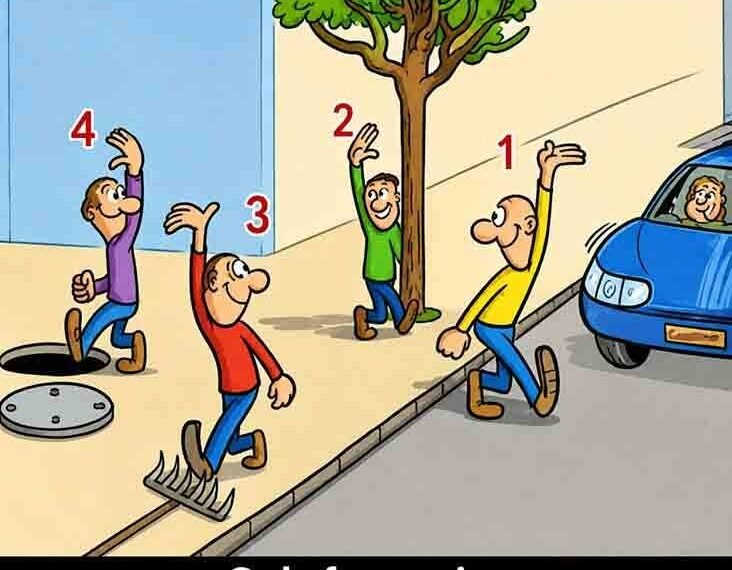
The key factor is that Person 3 is already using the tool.
Exposure is active.
If equipment fails, if insulation is damaged, or if water contacts energized components, consequences can occur rapidly.
Unlike Person 2, who can simply walk around a hazard, Person 3 is actively interacting with danger.
This increases risk substantially.
Why Familiarity Can Create False Confidence
Many accidents occur because people become comfortable with routine activities.
Power tools are common.
Most individuals use them safely.
Yet familiarity sometimes leads to underestimating danger.
This phenomenon appears throughout life.
People often become less cautious around hazards they encounter regularly.
The drill scenario illustrates this perfectly.
Person 4: Standing on Railroad Tracks
Railroad tracks immediately trigger danger recognition.
Most people understand instinctively that trains are extremely hazardous.
Unlike automobiles, trains cannot stop quickly.
Their enormous mass creates significant momentum.
Why Trains Are Uniquely Dangerous
Several factors contribute:
- massive weight
- long stopping distances
- limited maneuverability
- high speeds
Once a train approaches, options become limited.
This makes track safety critically important.
The Psychological Trap in the Train Scenario
Interestingly, many people focus exclusively on the approaching train.
But another question emerges:
Can Person 4 move?
If the person is physically able to step off the tracks, risk changes dramatically.
The hazard remains severe.
Yet avoidance may still be possible.
This creates an interesting contrast with lightning and electrocution.
How Time Influences Risk
Time matters enormously in safety analysis.
A hazard becomes less dangerous when:
- detection occurs early
- escape remains possible
- corrective action exists
The train is dangerous.
But if sufficient time remains, Person 4 retains options.
Options reduce risk.
Why This Puzzle Tricks So Many People
The puzzle exploits several psychological tendencies.
Dramatic Thinking
People focus on the most visually dramatic threat.
The approaching train captures attention immediately.
But dramatic appearance does not necessarily equal highest risk.
Emotional Reactions
Humans often judge danger emotionally rather than analytically.
The scenario that feels scariest may not actually be the most dangerous.
Ignoring Avoidability
Many individuals evaluate severity while forgetting avoidability.
Yet avoidance is one of the most important risk factors.
A visible danger is often safer than a hidden one.
The Science of Situational Awareness
Situational awareness is the ability to perceive environmental elements and understand their significance.
It involves:
- observation
- interpretation
- prediction
High situational awareness dramatically reduces accident rates.
Professionals in aviation, healthcare, engineering, and emergency response train extensively in this skill.
Person 2 benefits from situational awareness.
The hazard is visible and understandable.
This creates opportunities for safe action.
Why Invisible Dangers Are Often More Dangerous
Humans naturally fear visible threats.
Yet many of the world’s most dangerous hazards are invisible.
Examples include:
- electrical current
- toxic gases
- high blood pressure
- carbon monoxide
- radiation
- internal disease
Visibility influences perception more than actual danger.
The puzzle highlights this principle effectively.
The Role of Control in Safety
People tolerate risk differently depending on perceived control.
When individuals believe they can influence outcomes, danger feels smaller.
Examples:
- driving a car feels safer than flying for many people
- operating equipment feels safer than observing unknown machinery
Control shapes emotional responses.
Person 2 maintains substantial control over the situation.
The others possess far less.
Real-Life Lessons Hidden Inside the Puzzle
Beyond entertainment, the puzzle teaches practical safety principles.
Always Assess Visibility
Can you clearly identify the hazard?
Visibility improves decision-making.
Never Ignore Immediate Risks
Some dangers provide no second chance.
Lightning and electricity fall into this category.
Evaluate Escape Options
The ability to leave a dangerous situation changes risk dramatically.
Always identify exits and alternatives.
Don’t Let Drama Override Logic
The most frightening-looking threat is not always the most dangerous.
Careful analysis matters.
How Safety Professionals Think Differently
Safety experts rarely ask:
“What looks dangerous?”
Instead, they ask:
- What is the probability?
- What is the severity?
- What controls exist?
- What barriers reduce harm?
- What actions remain available?
This analytical approach often produces surprising conclusions.
The puzzle rewards this style of thinking.
Why Risk Assessment Matters Beyond the Puzzle
The same principles apply to everyday life.
People constantly evaluate:
- financial decisions
- health choices
- career moves
- travel plans
- relationships
- investments
Good decision-making depends on accurate risk assessment.
Those who understand risk tend to make better long-term choices.
The Surprising Importance of Preventive Thinking
The safest individuals are not necessarily the bravest.
Often, they are simply the most attentive.
They notice:
- environmental changes
- warning signs
- subtle dangers
- developing problems
Prevention consistently outperforms reaction.
Person 2 succeeds largely because the hazard is identified before harm occurs.
Why Awareness Is Humanity’s Greatest Safety Tool
Throughout history, survival has depended less on strength and more on awareness.
Awareness allows people to:
- avoid danger
- adapt quickly
- recognize patterns
- make informed decisions
The puzzle ultimately rewards awareness rather than courage.
And that distinction is important.
The Final Answer: Who Is the Safest?
After analyzing all four scenarios carefully, one conclusion emerges.
Person 1 faces immediate lightning danger.
Person 3 faces active electrical danger near water.
Person 4 stands in the path of a potentially catastrophic train hazard.
Person 2 encounters a visible, avoidable hazard.
The open manhole is certainly dangerous.
But because it can be seen and avoided easily, the overall risk is significantly lower.
This makes Person 2 the safest individual in the puzzle.
The Deeper Message Behind the Challenge
At first glance, this puzzle seems like a simple brain teaser.
Yet beneath the surface lies an important lesson about human judgment.
Life constantly presents risks.
Some appear obvious.
Others remain hidden.
The safest path is rarely determined by fear alone.
It requires observation.
Analysis.
Awareness.
And the ability to distinguish between a hazard that exists and a hazard that is likely to cause harm.
The puzzle reminds us that visible danger is often easier to manage than invisible danger. It teaches that awareness can transform risk. Most importantly, it demonstrates that good decisions come not from panic, but from thoughtful evaluation.
In a world filled with uncertainty, that lesson extends far beyond lightning, trains, power tools, and manholes.
It applies to every important choice we make.
And sometimes, the safest person is not the one farthest from danger.
It is the one who recognizes danger clearly enough to avoid it.