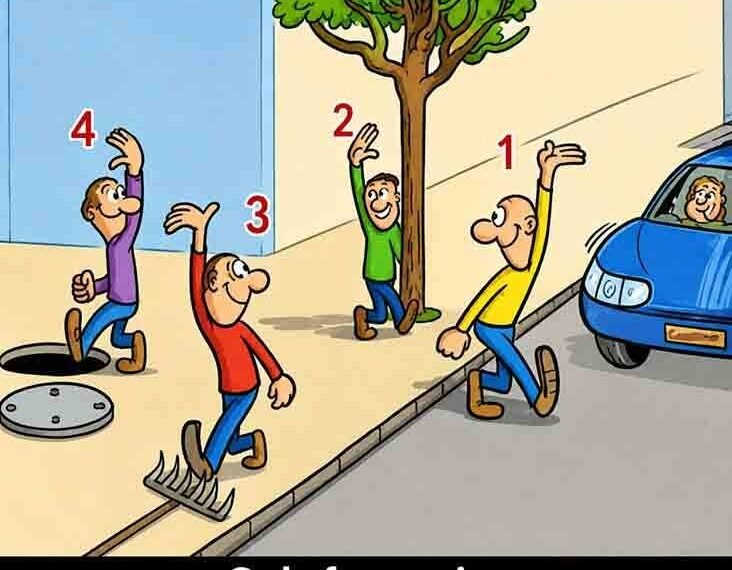
At first glance, the puzzle appears simple.
Four people stand in four different situations. Each faces a potential danger. The challenge is straightforward:
Which person is actually the safest?
Most people rush to answer within seconds.
Some immediately point to the railroad tracks and say the approaching train is the most dangerous threat. Others focus on the lightning storm. Many become alarmed by the power drill near water. A few concentrate on the open manhole.
Yet what makes this puzzle fascinating is not the answer itself.
It is the way people arrive at their answer.
This seemingly simple brain teaser exposes something surprisingly profound about human psychology, risk assessment, decision-making, survival instincts, and the way the human mind interprets danger.
The puzzle forces us to confront a critical question:
How do we decide what is truly dangerous?
The answer reveals far more than people realize.
Because in everyday life, danger rarely announces itself clearly. Some threats appear terrifying but are relatively avoidable. Others seem harmless until it is too late. Human beings constantly navigate visible risks, hidden risks, immediate threats, and long-term dangers without consciously analyzing them.
This puzzle compresses that reality into four simple scenarios.
And that is precisely why millions of people find it so intriguing.
The correct answer requires more than observation.
It requires understanding how risk actually works.
Why Safety Puzzles Fascinate the Human Mind
Human beings evolved by learning to identify danger quickly.
For our ancestors, survival depended on recognizing threats before they became deadly.
The brain became exceptionally skilled at scanning for:
- predators
- environmental hazards
- unstable terrain
- dangerous weather
- poisonous substances
- aggressive individuals
Even today, modern humans constantly evaluate risk without realizing it.
Every day we make decisions involving:
- driving
- crossing streets
- using electricity
- handling tools
- traveling
- interacting with strangers
- consuming food
- managing health
Our brains continuously ask:
“How dangerous is this?”
The puzzle taps directly into this ancient survival mechanism.
The Difference Between Perceived Danger and Actual Danger
One of the most important lessons in risk assessment is that perceived danger and actual danger are often different.
Humans tend to fear:
- dramatic events
- visible threats
- frightening scenarios
- emotionally charged situations
Meanwhile, they frequently underestimate:
- familiar dangers
- gradual risks
- routine hazards
- statistically significant threats
This mismatch creates fascinating mistakes in judgment.
People may fear flying intensely while ignoring unhealthy habits that pose greater long-term risks.
The same principle appears inside this puzzle.
The most obvious threat is not necessarily the most important factor.
Understanding Risk: The Three Questions Experts Ask
Professional safety analysts often evaluate hazards using three questions:
How Severe Is the Potential Harm?
Could the outcome be minor?
Serious?
Fatal?
Severity matters enormously.
How Likely Is the Harm?
Not every dangerous situation produces harm.
Probability influences overall risk.
Can the Person Avoid the Danger?
This is often the most overlooked factor.
A severe threat becomes less dangerous if it can be avoided easily.
A moderate threat becomes more dangerous if avoidance is impossible.
This principle is central to solving the puzzle correctly.
Person 1: Standing Under a Tree During a Lightning Storm
At first glance, many people immediately identify lightning as one of the most dangerous situations.
And for good reason.
Lightning is one of nature’s most powerful forces.
A lightning strike can release enormous amounts of electrical energy in an instant.
When thunderstorms occur, trees become particularly hazardous because they often act as natural lightning conductors.
Why Trees Become Dangerous During Lightning
Lightning seeks the path of least resistance toward the ground.
Tall isolated objects frequently attract strikes.
Trees are common targets because:
- they extend upward
- they contain moisture
- they provide conductive pathways
If lightning strikes a tree, energy may travel:
- through the trunk
- into nearby ground
- through surrounding roots
- into individuals standing nearby
The consequences can be catastrophic.
The Hidden Problem in Person 1’s Situation
The critical issue is not simply that lightning exists.
The problem is timing.
The storm is already active.
Person 1 is already positioned beneath the tree.
This means exposure is immediate.
Unlike many hazards that develop gradually, lightning can strike without warning.
There may be no opportunity for reaction.
This dramatically increases risk.
Why Immediate Hazards Matter
Risk is not only about severity.
It is about immediacy.
A threat that can occur instantly provides little time for corrective action.
This makes Person 1’s situation especially dangerous.
The individual has limited control over the environment.
And lack of control increases risk substantially.
Person 2: Walking Near a Missing Manhole Cover
At first glance, the open manhole seems dangerous.
And it certainly is.
Falling into an uncovered manhole could cause:
- fractures
- head injuries
- spinal injuries
- severe trauma
Yet something important differentiates this hazard from the others.
The danger is visible.
Why Visibility Changes Risk
Humans are remarkably effective at avoiding visible obstacles.
The brain constantly scans for:
- holes
- stairs
- curbs
- moving objects
- environmental dangers
When hazards are clearly visible, people can modify behavior.
This significantly reduces risk.
The open manhole remains dangerous.
But its visibility creates opportunities for prevention.
Risk Versus Hazard
A hazard is something capable of causing harm.
Risk measures the likelihood that harm will actually occur.
The manhole remains hazardous.
But because Person 2 can see it, the risk decreases dramatically.
This distinction is crucial.
Many people confuse hazards with risk.
The puzzle challenges that confusion directly.
How Awareness Becomes Protection
Awareness is one of the most powerful safety tools available.
Simply noticing a threat often eliminates much of its danger.
Examples include:
- spotting a slippery floor
- seeing a moving vehicle
- identifying damaged equipment
- recognizing unstable footing
Once detected, avoidance becomes possible.
Person 2 benefits from awareness.
And awareness changes everything.
Person 3: Using a Power Drill Near Water
Electricity and water form one of the most dangerous combinations encountered in daily life.
This scenario immediately raises concern because electrical current can travel through water efficiently.
When electrical tools operate near wet conditions, multiple dangers emerge.
Why Electricity Is So Dangerous
Unlike many hazards, electricity is often invisible.
People cannot see:
- electrical current
- voltage
- conductive pathways
As a result, danger may exist even when everything appears normal.
This invisibility makes electrical hazards especially deceptive.
Water Changes the Equation
Water dramatically increases conductivity.
Wet environments can:
- lower resistance
- increase current flow
- expand danger zones
- increase shock severity
Even experienced workers treat electricity near water with extreme caution.
The Immediate Risk in Person 3’s Situation
Click page 2 to continue