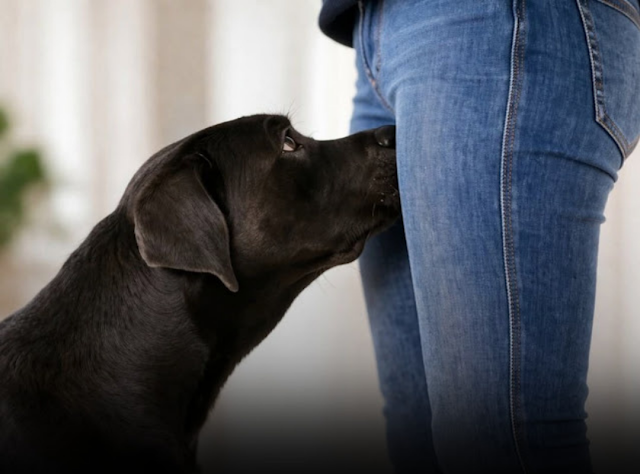
Few moments create awkward laughter faster than a dog enthusiastically sniffing someone’s crotch during a visit. One second everyone is chatting comfortably, and the next, a curious dog walks directly toward a guest and begins investigating the most socially uncomfortable area possible. Some people laugh nervously. Others pull away in embarrassment. Many owners apologize immediately, assuming their dog is behaving badly or disrespectfully.
But what if this behavior is not rude at all?
What if it is actually one of the purest forms of canine communication?
For dogs, scent is not just important — it is everything. Humans build their world primarily through vision. Dogs build theirs through smell. While people rely on facial expressions, clothing, body language, and words, dogs gather information through invisible chemical signals drifting through the air. Every human body carries an entire story written in scent, and dogs are biologically designed to read it with astonishing precision.
When a dog sniffs a person’s genital area, it is rarely about dominance, aggression, or sexual behavior. In most cases, it is simply the canine version of introducing themselves, gathering information, and understanding who stands before them. It may feel awkward in human society, but in the dog world, it is completely normal, deeply instinctive, and emotionally meaningful.
Understanding why dogs do this reveals something beautiful about the way animals experience connection, trust, curiosity, and emotional safety. It also teaches humans an important lesson about communication across species. The behavior that embarrasses us most may actually be a sign that a dog is trying — sincerely and innocently — to understand us.
The more we explore this fascinating instinct, the more we begin to see dogs not as poorly behaved pets, but as intelligent emotional beings navigating a human world with the only language nature gave them: scent.
Dogs Experience the World Through Smell, Not Sight
To truly understand why dogs sniff intimate areas, we first need to understand how dramatically different their sensory world is from ours.
Humans are visual creatures. We recognize people through faces, hairstyles, clothing, and movement. Our brains dedicate enormous power to processing visual information. Smell plays a relatively small role in daily human interaction.
Dogs, however, experience reality almost in reverse.
A dog’s nose is one of the most extraordinary biological tools in nature. Their sense of smell is estimated to be tens of thousands of times stronger than that of humans. Some experts believe dogs can detect certain scents at concentrations nearly unimaginable to the human mind.
While people walk into a room and notice furniture or colors, dogs immediately detect:
- Emotional states
- Hormonal changes
- Illness
- Stress levels
- Fear
- Sweat composition
- Recent activity
- Other animals
- Reproductive signals
- Familiar individuals
- Environmental changes
For dogs, scent is identity.
Every person carries a unique chemical signature, and dogs use this information to form impressions, assess safety, and understand social dynamics. To a dog, smell is not a secondary sense. It is their primary method of communication and perception.
This changes everything about how we interpret their behavior.
Why Dogs Focus on the Genital Area Specifically
One of the most common questions people ask is simple: why there?
Why do dogs seem especially drawn toward the crotch or genital region?
The answer lies in human biology.
Certain parts of the human body produce stronger scent signals than others because they contain higher concentrations of sweat glands known as apocrine glands. These glands release chemical compounds influenced by hormones, emotions, body chemistry, and individual biology.
Areas rich in these scent-producing glands include:
- The armpits
- The chest
- The neck
- The genital region
Because the genital area naturally contains a concentrated amount of scent information, dogs are instinctively drawn to it. From a canine perspective, this area functions almost like an identification card filled with emotional and biological data.
To humans, this feels socially invasive.
To dogs, it feels efficient.
They are not thinking in terms of embarrassment, social etiquette, or personal boundaries because those concepts belong to human culture, not canine instinct.
A dog sniffing someone’s crotch is often simply trying to answer basic social questions:
- Who are you?
- Are you familiar?
- Are you stressed?
- Are you healthy?
- Can I trust you?
- Are you afraid of me?
- Have you been around other animals?
In just seconds, dogs can gather information humans could never detect naturally.
Sniffing Is Canine Etiquette, Not Misbehavior
In dog society, sniffing is considered normal greeting behavior.
When dogs meet each other, they rarely shake paws or maintain eye contact the way humans do. Instead, they approach carefully, circle, sniff, and exchange chemical information.
This ritual may look strange to humans, but it serves several important social functions.
Sniffing helps dogs:
- Reduce uncertainty
- Assess emotional state
- Detect tension
- Identify familiarity
- Build trust
- Avoid unnecessary conflict
- Understand social hierarchy
- Recognize reproductive status
In many ways, scent investigation acts like a peaceful introduction.
A dog allowed to gather information through sniffing often becomes calmer afterward because the uncertainty disappears. They no longer need to guess whether someone is safe or threatening.
This is extremely important psychologically.
Animals rely heavily on predictability and information to feel secure. Preventing dogs from investigating their environment entirely can create stress, frustration, or anxiety.
Imagine entering a dark room blindfolded while someone continually stops you from understanding your surroundings. That uncertainty would feel uncomfortable and even frightening.
For dogs, scent provides orientation and emotional reassurance.
Dogs Are Not Trying to Embarrass You
One of the funniest aspects of this behavior is how emotionally uncomfortable humans become while dogs remain completely innocent.
Dogs do not understand social embarrassment the way humans do.
They are not intentionally trying to humiliate guests or create awkward situations. In fact, most dogs approach sniffing with complete sincerity and curiosity.
To them, they are simply learning.
This innocence is important to remember because many owners react harshly out of embarrassment. They yank leashes, yell, panic, or punish the dog aggressively in front of guests.
Unfortunately, this can confuse dogs deeply.
The dog often has no idea why they are suddenly being scolded for performing a biologically normal social behavior.
Over time, harsh punishment can create:
- Anxiety around greeting people
- Fearful social interactions
- Confusion
- Stress responses
- Reduced trust
- Hypervigilance
Dogs thrive best when guidance is calm, respectful, and consistent rather than emotionally reactive.
Why Some Dogs Sniff More Than Others
Not every dog behaves the same way. Some dogs briefly sniff and move on, while others become intensely curious around certain individuals.
Several factors influence sniffing behavior, including personality, breed, training, confidence, and environmental stimulation.
Certain dogs are naturally more scent-driven than others. Breeds historically developed for scent work often display stronger investigative instincts.
These include:
- Beagles
- Bloodhounds
- Basset Hounds
- German Shepherds
- Labrador Retrievers
- Belgian Malinois
- Springer Spaniels
These dogs possess extraordinary scent-processing abilities and tend to rely heavily on olfactory exploration.
Additionally, some situations produce stronger scent signals that attract canine curiosity more intensely.
Dogs may become especially interested in people who:
- Recently exercised
- Are pregnant
- Are menstruating
- Have other pets at home
- Feel nervous or fearful
- Wear strong scents
- Recently interacted with animals
- Experience hormonal fluctuations
Dogs are incredibly sensitive to biological changes humans barely notice themselves.
Can Dogs Detect Emotions Through Smell?
One of the most astonishing discoveries in canine behavior research is that dogs appear capable of detecting human emotions through scent.
When humans experience emotions such as fear, stress, anxiety, happiness, or excitement, the body releases subtle chemical changes through sweat and hormones. Dogs can often perceive these shifts almost instantly.
This means your dog may already know:
- When you are anxious
- When you are sad
- When you are stressed
- When you are calm
- When you are emotionally tense
Many dog owners notice that their pets behave differently during emotional moments. Some dogs become more affectionate during sadness, while others become alert during tension or conflict.
Scent gives dogs access to emotional information hidden beneath human words and facial expressions.
This deepens the emotional significance of sniffing behavior. Dogs are not merely collecting random smells. They are reading emotional landscapes invisible to humans.
Why Guests Often Feel Uncomfortable
Even though sniffing is biologically normal for dogs, it can still create genuine discomfort for people.
Human society places enormous importance on personal space and body boundaries. The genital area is considered highly private, so sudden canine attention there can feel invasive or embarrassing.
Click page 2 to continue