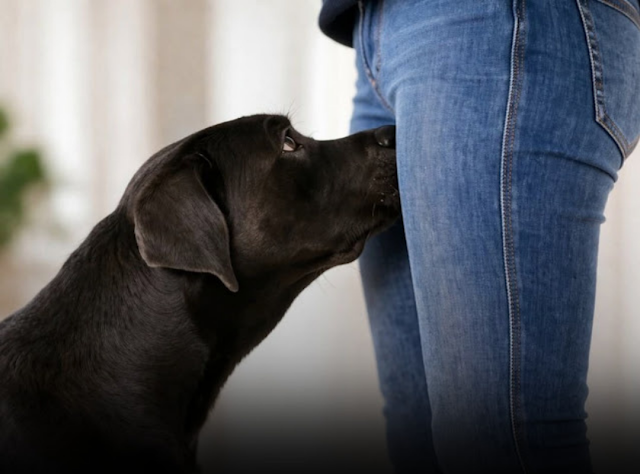
Additionally, many people misunderstand the behavior and assume the dog is:
- Being dominant
- Acting sexually
- Targeting them intentionally
- Misbehaving aggressively
In reality, the dog is usually motivated by curiosity and instinct rather than social intention.
However, respecting human comfort matters too.
Dog owners should not shame their pets for natural behavior, but they should also help dogs navigate human social expectations in healthy ways.
The goal is balance, not punishment.
Bridging Two Worlds With Compassion
Dogs live in a human society full of rules they did not create.
They do not naturally understand:
- Personal boundaries
- Formal greetings
- Social embarrassment
- Human etiquette
- Cultural expectations
As caretakers, humans help dogs adapt to these environments gently and respectfully.
The healthiest approach is not suppressing canine instincts entirely but redirecting them appropriately.
Instead of punishing curiosity, owners can guide dogs toward socially comfortable alternatives.
This creates partnership rather than fear.
Teaching Dogs More Polite Greeting Habits
A well-trained dog can still express natural curiosity while respecting human comfort.
One effective method involves teaching alternative greeting behaviors.
For example, owners can train dogs to:
- Sit calmly when guests arrive
- Sniff hands instead of intimate areas
- Touch a hand target
- Focus on the owner
- Wait for permission before approaching
Positive reinforcement works far better than punishment.
When dogs receive rewards for calm greetings, they gradually learn what behaviors earn positive outcomes.
This process preserves emotional trust while teaching social structure.
Training should feel cooperative, not intimidating.
Why Positive Reinforcement Matters So Much
Dogs learn best through emotional clarity and consistency.
Punishment-based methods often create fear without genuine understanding. A dog may stop approaching guests entirely, not because they learned manners, but because they became anxious about social interaction.
Positive reinforcement teaches confidence.
When dogs feel emotionally safe, they become more adaptable and responsive.
Owners who remain calm during awkward sniffing moments communicate stability to their dogs. Emotional overreaction, on the other hand, can amplify canine stress.
Dogs are remarkably sensitive to human emotional energy.
A calm redirection such as:
“Come sit here.”
“Good boy.”
“Let’s say hello nicely.”
often works far better than panic or anger.
The Emotional Intelligence of Dogs
The more scientists study dogs, the more emotionally intelligent they appear.
Dogs are capable of:
- Recognizing emotional patterns
- Forming deep attachments
- Reading body language
- Understanding routines
- Detecting emotional shifts
- Responding empathetically
Their social intelligence evolved over thousands of years alongside humans.
This partnership shaped dogs into one of the most emotionally attuned species on Earth.
Sniffing behavior is part of that intelligence system.
Dogs seek information because information helps them navigate relationships safely and effectively.
Their curiosity is rarely malicious.
In fact, it often reflects trust and social engagement.
Why Dogs Depend on Predictability
Many canine behaviors become easier to understand once we recognize how strongly dogs depend on predictability.
Dogs feel safest when they understand:
- Their environment
- The people around them
- Social expectations
- Emotional energy
- Daily routines
Sniffing helps reduce uncertainty.
When dogs investigate a person through scent, they gather information that helps them predict safety and behavior. This creates emotional stability.
Preventing investigation entirely can increase nervousness because uncertainty remains unresolved.
This explains why some dogs continue obsessively sniffing new guests until they feel emotionally satisfied with the information gathered.
The Hidden Beauty Behind Canine Curiosity
Although humans often react to genital sniffing with embarrassment, there is something unexpectedly touching about it too.
Dogs approach the world with openness and honesty.
They do not pretend.
They do not judge social status, appearance, wealth, or popularity the way humans often do. They respond to emotional energy, familiarity, and instinct.
When a dog sniffs someone curiously, they are engaging with the world authentically.
They are trying to understand.
Trying to connect.
Trying to determine safety and familiarity.
This perspective transforms the behavior from something shameful into something deeply natural.
How Humans Misinterpret Animal Behavior
One of the biggest challenges in understanding animals is that humans constantly interpret behavior through human psychology.
People assume dogs experience:
- Embarrassment
- Revenge
- Manipulation
- Spite
- Social humiliation
But dogs experience the world differently.
Most canine behaviors arise from instinct, emotion, learning history, and environmental response rather than complex social schemes.
When people misunderstand this, they may punish dogs unfairly for behaviors rooted in biology rather than rebellion.
Learning canine communication improves not only training but also emotional connection.
The Importance of Empathy in Dog Ownership
Responsible dog ownership is not simply about obedience. It is about understanding another species compassionately.
Dogs spend their lives adapting to human expectations:
- Living indoors
- Following schedules
- Ignoring instincts
- Walking on leashes
- Navigating crowds
- Suppressing natural behaviors
Empathy matters because dogs are constantly translating themselves into a world built for humans.
Owners who understand natural canine behavior tend to build stronger, healthier relationships with their pets.
Compassion does not mean allowing every behavior endlessly. Boundaries remain important.
But boundaries work best when paired with understanding rather than shame.
What Your Dog Might Really Be Saying
The next time your dog approaches someone curiously and begins sniffing awkwardly, pause before reacting emotionally.
From the dog’s perspective, they may simply be saying:
“Who are you?”
“Are you safe?”
“You smell nervous.”
“You remind me of someone.”
“I want to understand you.”
“You are new here.”
This changes the emotional meaning entirely.
The behavior becomes less about invasion and more about communication.
Dogs Teach Humans Powerful Lessons About Authenticity
In many ways, dogs expose the contradictions within human social behavior.
Humans often hide emotions behind politeness, appearances, and controlled conversation. Dogs bypass all of that instantly.
They respond to energy more than performance.
A dog does not care about job titles, luxury clothing, or social image. They care about emotional truth.
This authenticity explains why so many people feel emotionally comforted by dogs. Animals interact without pretense.
Their curiosity is honest.
Their affection is direct.
Their communication is genuine.
Even awkward sniffing becomes part of that raw honesty.
Final Thoughts: It’s Not Misbehavior — It’s Communication
The next time a dog sniffs someone’s genital area and everyone bursts into awkward laughter, remember what is truly happening beneath the surface.
A dog is not trying to embarrass anyone.
They are not violating social rules intentionally.
They are not being “bad.”
They are doing what nature designed them to do: gathering information through scent in order to understand the world around them.
To dogs, smell is language.
And sniffing is conversation.
This instinct reflects curiosity, emotional intelligence, social connection, and biological communication far older than human etiquette itself.
Of course, dogs still need guidance to navigate human social spaces comfortably. Teaching polite greetings through patience and positive reinforcement helps bridge the gap between canine instinct and human boundaries.
But understanding the reason behind the behavior changes everything.
Instead of frustration, there is empathy.
Instead of shame, there is perspective.
Instead of punishment, there is communication.
And perhaps that is the most beautiful part of living with dogs.
They constantly remind humans that connection does not always begin with words.
Sometimes, connection begins with curiosity.
Sometimes, it begins with trust.
And sometimes, in the wonderfully strange language of dogs, it begins with a sniff.